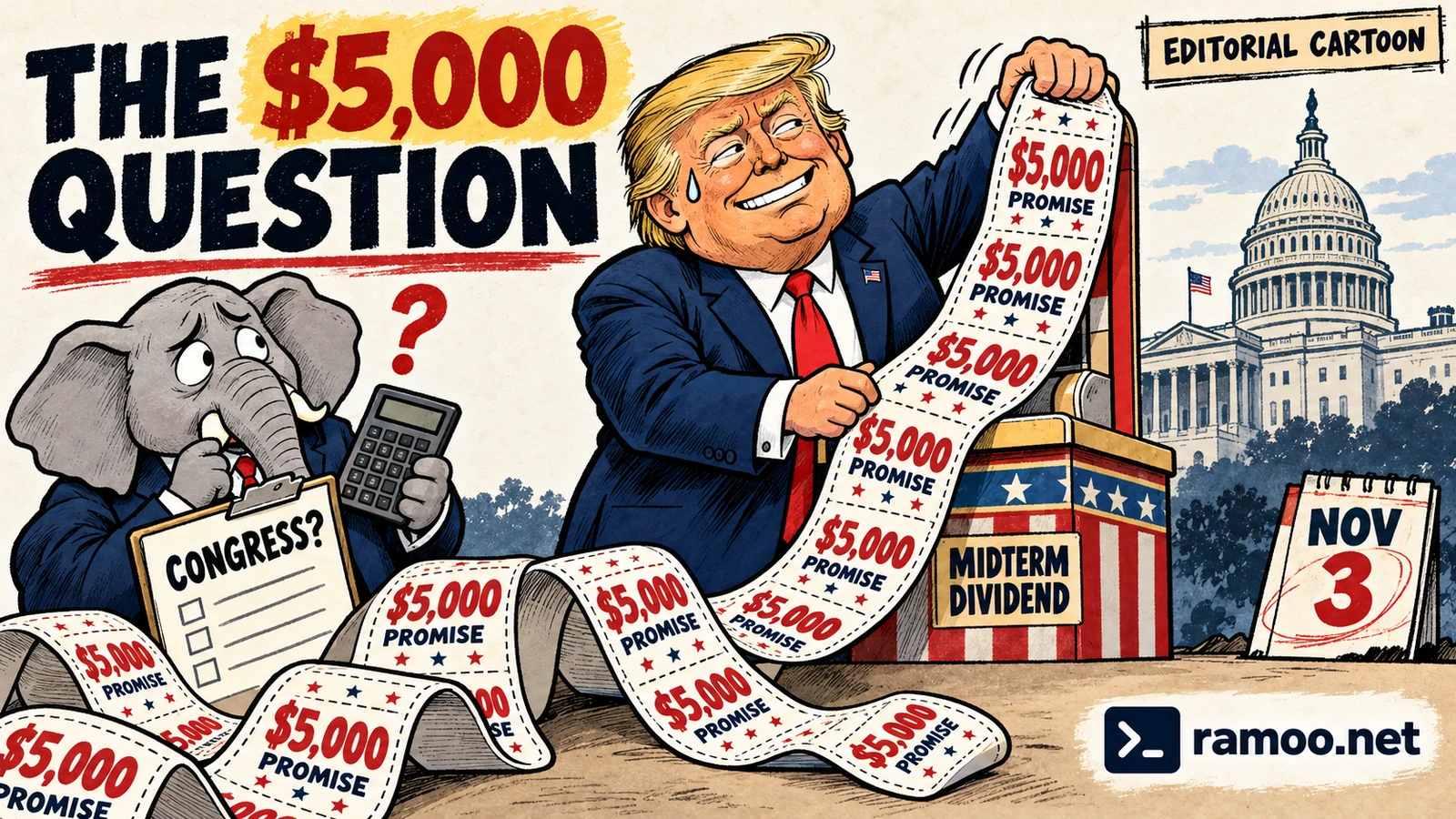
The November 3 midterms are getting closer, and Donald Trump has brought a very large number to the campaign: US$5,000 (about ₩6.71 million at the October 9, 2026 exchange rate).
For a president trying to help his party hold Congress, it is certainly an attention grabber. But is this a confidence move—or the political equivalent of hitting the big red button?
News roundup and personal commentary, checked October 19, 2026. The quotation below is brief; the other news excerpts are summaries, not copied articles or social-media posts.

An original AI-generated editorial illustration, not a photograph of an actual event.
News reshared: a $5,000 promise, with a very large “if”
“we’re going to get you $5,000”
— Donald Trump, quoted in AP’s September 18 report.
The offer was conditional on Republicans keeping both chambers of Congress. AP found little sign that competitive-race candidates were making the pledge their own; Democrats questioned whether it would materialize. That is a campaign promise, not an approved payment. AP, September 18
The Guardian reported accusations of vote-buying. That describes critics’ reaction, not a criminal conviction.
There is also an awkward institutional detail. House Speaker Mike Johnson said Congress would need to approve the proposal, while Trump had suggested otherwise. AP reported a potential price tag above US$1 trillion (about ₩1,342 trillion at the same exchange rate). AP, September 13
My take: the headline fits on a campaign sign. The funding plan, eligibility rules, and legislative votes need a little more room.
KRW equivalents use ₩1,342.13 per US$1 on October 9, 2026, from the Federal Reserve exchange-rate series DEXKOUS on FRED. US$5,000 converts to ₩6,710,650, rounded above to ₩6.71 million. The observation date differs from this article’s publication date; conversion fees are excluded.
News reshared: why start with the home crowd?
AP’s September 25 reporting described an early-October itinerary beginning in Alabama and Oklahoma, after Trump promised visits to 35 competitive races. Organizers said the locations could also reach neighboring media markets. This was a report about that itinerary—not proof that every battleground visit was canceled. AP reporting, republished by WBHM
“Thirty-five races” does not mean 35 swing states. And Texas was part of the neighboring-market rationale for the Oklahoma stop, rather than the second location in that reported pair.
My read: big crowds have two possible jobs: project momentum and persuade people who already like you to actually show up. A rally can look like a victory lap while doing defensive work. That is an interpretation of the strategy, not a window into Trump’s private state of mind.
The pressure behind the performance
The October 8–12 AP-NORC survey found 36% job approval among registered voters. On preferred House control, Democrats led Republicans 47% to 38%. The overall study interviewed 1,119 adults; those voter figures are a subgroup. A national preference poll is not a seat forecast. AP-NORC, October 15
That gives the “feeling the heat?” question some substance. It does not establish that any single issue caused the approval number, or that the election is already decided.
If Republicans lose, what happens next?
The following is my scenario analysis, not a forecast from AP or a claim that the result is settled. “Lose” also needs a definition: losing one chamber and losing both produce different constraints.
House lost, Senate held: expect a more expensive political negotiation
A Democratic House would give the opposition a gatekeeping role over new legislation. Bills generally need approval from both chambers before reaching the president. House guide to lawmaking
My expectation: tougher spending negotiations and more confrontational oversight. A large new payment plan would need a bargain, not just a rally announcement. A shutdown would be a risk if funding talks failed, not an automatic consequence of the election. A Republican Senate would still matter for appointments.
Senate lost: the personnel pipeline becomes a pressure point
The Senate considers presidential nominations for federal judges and many senior executive positions. Senate guide to nominations
My expectation: nominees face more resistance, negotiation, or delay. That would not automatically remove officials already in office. If Democrats took both chambers, the administration would face opposition control of both legislative agendas as well as Senate confirmations.
Both lost: confrontation, selective deals, and a fight over 2028
I would expect the White House to lean harder on actions it can take under existing executive authority, while Congress presses for concessions. Those powers still have statutory and constitutional limits; executive orders are not a substitute for every blocked bill. Trump would also retain the veto, and overriding it generally requires two-thirds in each chamber. Senate explanation of vetoes
Inside the GOP, a poor result could intensify arguments over whether to defend Trump’s approach or put distance between it and the next presidential campaign. That could weaken his leverage without ending his influence over the base. Narrow deals on specific issues would remain possible; permanent gridlock is not the only scenario.
Would defeat mean impeachment—or immediate removal?
No automatic chain reaction. The House can approve impeachment articles by a simple majority, but conviction and removal require two-thirds of senators present. A partisan majority alone does not establish grounds or guarantee those votes. Senate guide to impeachment
My base case after a meaningful GOP defeat: Trump stays president, but governing becomes more contested. The $5,000 proposal could fade, shrink, or reappear as a bargaining chip. Its condition would have failed as originally pitched; whether any revised payment emerges would depend on a new proposal and the necessary approvals. I would watch the size of the defeat, the congressional margins, and the first funding negotiations before declaring a full lame-duck presidency.
My real question: will stocks go up?
After all the political drama, this is where my attention lands: what does it mean for stocks?
My view is that a Republican defeat would not automatically be bearish, but it would not establish a bullish case either. Fidelity’s midterm analysis emphasizes policy uncertainty and fundamentals such as earnings, business investment, and economic conditions over the winning party. Historical post-election gains are not a promise about this election. Fidelity on midterms and stocks
Here are the paths I would watch—not price forecasts:
- A supportive outcome: a clear result reduces uncertainty about major policy changes, while interest rates stabilize and corporate earnings improve. Political gridlock could coexist with rising share prices.
- A difficult outcome: prolonged funding fights or renewed tariff and foreign-policy conflict raises business costs and inflation concerns. Divided government would not make those risks disappear.
- An expected outcome: if markets had already anticipated a GOP defeat, the next earnings outlook or move in yields could matter more than the result itself.
The $5,000 proposal is also more complicated than “cash payments lift stocks.” Spending could support consumption, while additional fiscal, inflation, or interest-rate pressure could work against valuations. Scrapping payments could reduce both the expected consumption boost and the fiscal burden. Those are competing mechanisms in my scenario, not a quantified forecast.
I would watch Treasury yields, earnings expectations, and actual policy proposals before treating a victory speech as a market signal. A broad index and an individual company need not react alike.
My conclusion: political gridlock is not an automatic sell signal. Less election uncertainty, stable rates, and improving earnings could create room for gains. The election result alone leaves too many variables unresolved to make it my reason to buy. I am watching the politics, but looking to earnings and rates for the investment story.